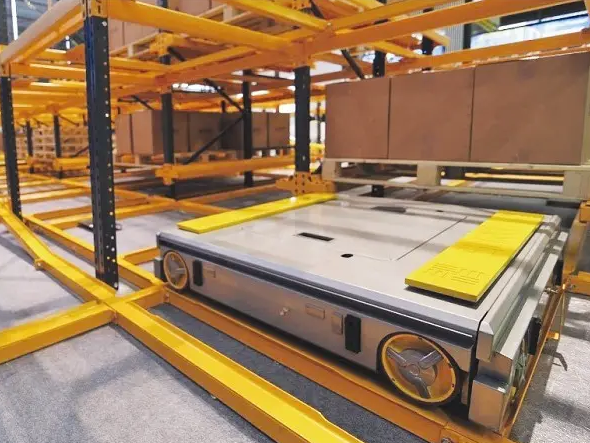
In automated storage and retrieval systems (AS/RS) and dense storage facilities, shuttle carts handle pallets and totes at high speed. As the only contact point between the shuttle and its track, wheel performance directly affects travel stability, positioning accuracy, noise levels, and maintenance intervals. With wear resistance, quiet operation, and stable load capacity, polyurethane-coated wheels have become a mainstream choice for four-way shuttles, stacker cranes, and other intelligent warehousing equipment. This article covers structural features, key advantages, selection criteria, and customization services to support your procurement decisions.
1. What Are Polyurethane Shuttle Cart Wheels?
Polyurethane shuttle cart wheels use a metal core as the structural frame, coated with a polyurethane (PU) elastomer layer. Mounted on the shuttle chassis, they contact the track or floor directly, carrying the vehicle’s weight and enabling rolling travel. Depending on mounting position and function, they are classified as drive wheels, load wheels, and guide wheels.
The PU coating bonds firmly to the metal core through casting or molding, providing structural strength while delivering the required wear resistance, elasticity, and friction coefficient at the wheel surface. Hardness is typically adjusted between Shore A85 and Shore D60 to suit different load and track conditions.
2. Key Advantages of Polyurethane Shuttle Cart Wheels
1. Outstanding wear resistance for high-frequency reciprocating operation
Shuttle carts travel back and forth over long distances at high frequency in AS/RS facilities, placing high demands on wheel wear. Polyurethane significantly outperforms standard rubber in wear resistance, resisting particle shedding and cracking under frequent starting, stopping, and acceleration. This extends replacement intervals and reduces maintenance downtime costs.
2. Smooth operation and high positioning accuracy
The elastic PU layer absorbs vibration from track joints and minor irregularities, ensuring smooth shuttle travel. Combined with uniform surface hardness and precise dimensional tolerances, it helps improve stopping positioning accuracy—meeting the strict requirements of dense storage systems for slot alignment.
3. Low noise for a better warehouse environment
Polyurethane offers excellent vibration damping and noise reduction. Shuttles running on steel tracks or concrete floors produce noticeably less noise than with hard wheels, making PU wheels suitable for modern warehouses with noise requirements.
4. Track-friendly and floor-protective
The PU coating is gentle on steel tracks and epoxy floors, leaving no scratches or indentations. This reduces track wear and extends track service life.
5. Adjustable friction coefficient for both driving and braking
By adjusting the PU formula, an appropriate friction coefficient can be achieved—ensuring drive wheels have sufficient traction for acceleration and deceleration while avoiding excessive friction that increases energy consumption or causes abnormal wheel surface wear.
6. Stable load capacity without deformation
High-hardness polyurethane maintains good compression resistance under sustained heavy loads. The wheel body resists permanent deformation, ensuring long-term stable shuttle operation.
3. Typical Applications
-
Four-way shuttles: direction-changing travel wheels in dense storage systems, requiring wear resistance and flexible steering
-
Two-way shuttles: pallet/tote handling with high-frequency reciprocating travel
-
Stacker cranes: travel and guide wheels requiring positioning accuracy and smooth operation
-
AGV/AMR: warehouse robot travel wheels balancing quiet operation and load capacity
-
AS/RS rail systems: rail travel wheels that protect tracks and reduce noise
4. Selection Guide for Polyurethane Shuttle Cart Wheels
1. Load requirements
Select wheel diameter, width, and hardness based on actual per-wheel load. Shuttles typically use multi-point support structures, so per-wheel forces must be calculated with a safety margin. For heavy-duty applications, prioritize wider wheel bodies or higher-hardness formulas.
2. Hardness selection
Hardness affects load capacity, friction, and cushioning. Too low, and load capacity is insufficient with faster wear; too high, and cushioning decreases while noise increases. Determine the balance based on load, track conditions, and noise requirements.
3. Core material and structure
Cores are commonly cast iron, cast steel, or aluminum alloy. Cast iron offers high strength at moderate cost; aluminum alloy is lightweight and suits high-speed shuttles sensitive to inertia. Shaft holes, keyways, and bearing seats must precisely match the shuttle drive structure.
4. Friction coefficient requirements
Drive wheels require higher friction coefficients for acceleration and deceleration performance, while load and guide wheels prioritize low rolling resistance and wear resistance. Specify the functional requirements of each wheel position during customization so the formula can be adjusted accordingly.
5. Operating environment
For cold storage, select low-temperature-resistant PU formulas to avoid brittleness. For oily or chemical-exposed areas, confirm the formula’s resistance performance. For high-cleanliness warehouses, consider whether the wheel body sheds particles.
5. Our Polyurethane Shuttle Cart Wheel Customization Services
We offer polyurethane shuttle cart wheels in multiple specifications along with customization services:
Every product is tested for load capacity and wear resistance before shipment to ensure surface consistency and smooth operation. Drawing-based and sample-based customization are supported, with full follow-through from prototyping to volume production.
Contact us today for product information, selection support, and a quote on polyurethane shuttle cart wheels.