
Polyurethane coated wheels are widely used in industrial applications due to their excellent load-bearing capacity, wear resistance, and floor protection. To ensure optimal performance and longevity, selecting the right wheel requires careful evaluation of several critical parameters:
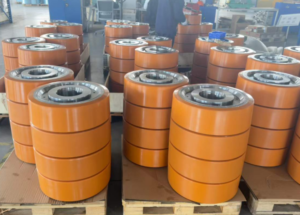
1. Hardness (Shore A Scale)
Hardness directly impacts the wheel’s load capacity, rolling resistance, and shock absorption. It is typically measured on the Shore A scale (e.g., 80A, 90A, 95A).
Lower Hardness (e.g., 80A-90A): Offers better shock absorption, quieter operation, and higher comfort on uneven surfaces. However, it has higher rolling resistance and generates more heat.
Higher Hardness (e.g., 92A-98A): Provides superior load-bearing capacity, lower rolling resistance, and better wear resistance on smooth floors. The trade-off is increased noise and vibration.
2. Load Capacity
Always calculate the required load capacity per wheel based on the total weight of the equipment and its maximum payload. It is highly recommended to include a safety factor (typically 1.5 to 2.0 for motorized equipment) to account for uneven weight distribution, dynamic impacts, and varying floor conditions. Overloading a wheel can lead to premature deformation, internal heat buildup, and cracking.
3. Operating Speed and Duty Cycle
Continuous high-speed operation generates significant internal heat within the polyurethane material. For high-speed or continuous-duty applications, a higher hardness PU formulation is required to minimize rolling resistance and prevent heat-induced degradation. For low-speed or intermittent use, a slightly softer compound can be utilized to enhance comfort and reduce noise.
4. Floor and Track Conditions
The condition of the operating surface plays a vital role in wheel selection:
Smooth Floors (e.g., Epoxy, Tile): Harder PU wheels (92A-98A) are ideal for maximizing service life and minimizing rolling resistance.
Rough or Uneven Surfaces (e.g., Concrete with joints, Outdoor): Softer PU wheels (85A-92A) are recommended to absorb shocks, reduce noise, and protect both the wheel and the floor.
5. Environmental Factors
Standard polyurethane performs best in moderate temperatures. Extreme environments require specialized formulations:
Low Temperatures: PU becomes harder and more brittle. Special anti-freeze formulations may be necessary to maintain elasticity and prevent cracking.
High Temperatures: Prolonged exposure to high heat can cause softening and reduced load capacity. High-temperature resistant PU is required for such conditions.
Chemical Exposure: If the wheel will be exposed to oils, solvents, or harsh chemicals, ensure the PU formulation is specifically engineered for chemical resistance.
6. Wheel Core Material and Bonding
For heavy-duty and high-frequency applications, always opt for a metal core (steel or aluminum) rather than a plastic core, as plastic cores are prone to thermal expansion and deformation under heavy loads. Additionally, ensure the manufacturer uses advanced vulcanization processes to guarantee a strong bond between the PU layer and the metal core, preventing delamination during operation.
7. Noise and Vibration Requirements
If the equipment operates in noise-sensitive environments (e.g., laboratories, hospitals, or offices) or transports fragile goods, prioritize wheels with lower Shore A hardness to effectively dampen vibrations and ensure quiet operation.
By carefully matching these parameters to your specific application requirements, you can significantly extend the service life of your polyurethane wheels and maximize equipment efficiency.