
In heavy equipment manufacturing, mold transfer, and wind power assembly, loads often reach several tons or even tens of tons—far beyond the capacity of standard casters. Heavy-duty casters are specifically engineered for super-heavy loads, and their structural strength, load capacity, and reliability directly affect operational safety and handling efficiency. This article covers structural features, material selection, key advantages, selection criteria, and customization services to support your procurement decisions.
1. What Are Heavy-Duty Casters?
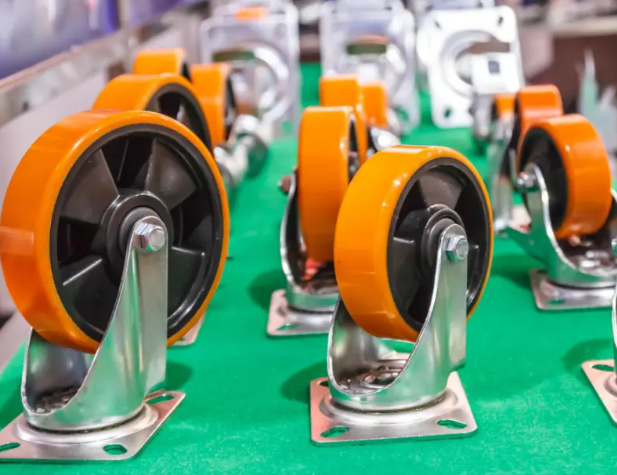
Heavy-duty casters are caster products designed for super-heavy load conditions. They typically consist of reinforced metal brackets, large-diameter wheel bodies, heavy-duty bearings, and strengthened mounting plates. Compared with standard casters, heavy-duty models feature significantly thicker brackets, stronger wheel structures, larger bearings, and reinforced welding. Per-wheel load capacity typically starts at several hundred kilograms and can reach several tons or more in high-end products.
By function, heavy-duty casters are classified as rigid casters, swivel casters, and swivel casters with brakes. By wheel material, they include polyurethane, nylon, cast iron, and rubber wheels, each suited to different floor conditions and operating environments.
2. Key Advantages of Heavy-Duty Casters
1. Exceptional load capacity
Heavy-duty casters use thickened steel plate brackets and reinforced welding, combined with large-diameter, wide wheel faces, achieving per-wheel load capacities of several tons. When used in multi-wheel configurations, the complete caster system can carry heavy equipment weighing tens of tons, meeting the handling requirements of large workpieces and equipment.
2. Sturdy construction, impact-resistant and durable
Under heavy loads, casters must withstand frequent starting, stopping, steering, and surface impacts. Thickened brackets, reinforced bearing seats, and strengthened welds effectively distribute stress, preventing bracket deformation and fracture for long-term reliability.
3. Low rolling resistance for effortless pushing
Large-diameter wheel bodies combined with heavy-duty roller bearings significantly reduce rolling resistance. Even when carrying loads of several tons, operators can achieve smooth movement using towing equipment or manual effort, reducing labor intensity and equipment wear.
4. Multiple material options for diverse conditions
-
Polyurethane wheels: wear-resistant, quiet, and floor-friendly—suitable for indoor flat floors
-
Nylon wheels: high load capacity and wear resistance—suitable for heavy loads and rough floors
-
Cast iron wheels: extremely high load capacity and heat resistance—suitable for extreme heavy loads and high-temperature environments
-
Rubber wheels: good shock absorption and traction—suitable for precision equipment sensitive to vibration
5. Safe and reliable braking
Heavy-duty swivel casters with brakes feature reinforced braking mechanisms that lock reliably on slopes or during frequent start-stop operation, preventing accidental equipment movement and ensuring operational safety.
3. Typical Applications
-
Heavy equipment manufacturing: movement and positioning of large machine tools, stamping equipment, and injection molding machines
-
Mold transfer: in-plant transfer of large molds, fixtures, and tooling
-
Wind power equipment: assembly and transfer of wind turbine blades and nacelle components
-
Warehouse logistics: heavy-duty handling of racks, containers, and pallets
-
Aerospace: movement of large component assembly fixtures and transfer platforms
-
Port and marine: short-distance handling of heavy equipment and cargo
4. Selection Guide for Heavy-Duty Casters
1. Load capacity calculation
Calculate per-wheel load based on total equipment weight and caster count, with an adequate safety margin (recommended at least 1.5×). Distinguish between dynamic and static loads; applications with significant impact loads require even greater safety margins.
2. Wheel material selection
Select wheel material based on floor conditions and operating environment. For indoor epoxy floors, polyurethane wheels are preferred for floor protection and quiet operation. For rough floors or high-temperature environments, choose nylon or cast iron wheels. For precision equipment sensitive to vibration, rubber wheels are suitable.
3. Wheel diameter and width
Larger diameters roll more easily over floor obstacles and reduce rolling resistance; greater widths increase load capacity and reduce floor pressure. For heavy-duty applications, large-diameter, wide-face designs are recommended.
4. Brackets and bearings
Bracket thickness, welding quality, and bearing specifications directly determine load capacity and service life. For heavy-duty applications, choose thickened brackets and heavy-duty roller bearings to ensure structural stability under sustained high loads.
5. Mounting method and braking requirements
Select plate mounting, bolt mounting, or other configurations based on equipment structure, and confirm mounting hole positions and plate dimensions. For applications requiring frequent positioning or slope operation, configure reliable braking devices.
5. Our Heavy-Duty Caster Customization Services
We offer heavy-duty casters in multiple specifications along with customization services:
-
Product types: rigid casters, swivel casters, and swivel casters with brakes
-
Load customization: bracket thickness, wheel diameter, and bearing specifications tailored to equipment weight and operating conditions
-
Mounting customization: drawing-based customization of mounting plates, hole positions, and connection structures
-
Quality testing: load, impact, braking, and dimensional accuracy tested before shipment
Every product is tested for load capacity and impact resistance before shipment to ensure structural strength and operational safety. Drawing-based and sample-based customization are supported, with full follow-through from design to volume production.
Contact us today for product information, selection support, and a quote on heavy-duty casters.